9 Ways to Come Up with Newsletter Ideas Every Week
Most newsletters die because the writer runs out of topics. Here are 9 AI-powered methods to generate endless ideas, plus how to draft them automatically.

6 min read

What if the biggest bottleneck in your newsletter isn't the writing?
It's the 30 minutes you spend every week convincing yourself there's nothing to say.
I tracked this in my own process. The writing part? Fine once I get going. But the staring-at-a-blank-doc part, the "what do I even talk about this week" spiral, that's where I'd lose an hour before a single word hit the page.
And I'm not alone. 90% of content producers have experienced burnout, and 51% say the hamster wheel of constantly coming up with new ideas is a primary stressor.
Newsletters fail because they run out of good topics. So I stopped treating ideation like a creative exercise and started treating it like an AI-powered system.
Now? My content calendar is so full I actually have to prune it back. Here are the nine ways to come up with newsletter ideas every week, and how to write them all without lifting a finger.
9 ways to generate endless newsletter ideas fast

I tested all of these personally. Some I stumbled into, some I engineered deliberately. All of them work on repeat.
1. Codebase audits
This one blew my mind. I connected Claude to my Flyletter GitHub and said, "tell me what's interesting about how I built this."
It came back with observations about Flyletter's multi-agent pipeline, the voice profiling system, prompt engineering patterns I hadn't even thought to write about. 10 to 15 topic ideas in minutes. If you're building software, your repo is a content wellspring you're just sitting on.
2. Deep research mining
I've done dozens of deep research sessions with Claude for personal and business decisions over the past year. Turns out, all those reports are full of insights worth sharing. I had Claude analyze the whole batch and pull out the stuff my audience would care about. Your past research is a library of topics you've already validated with your own time.
3. Audio data dumps
My favorite. I keep a Flyletter tab open on my phone. Idea hits me mid-walk? I record it. Shower thought? I grab my phone the second I'm out.
Those voice notes get transcribed and fed into Flyletter to extract and organize into saved ideas. Stream-of-consciousness in, structured topics out. No notes app graveyard.
4. Customer call transcripts
Every sales call, support conversation, and demo you've ever had is packed with questions your audience is already asking. Feed those transcripts into AI, let it surface patterns. Done.
5. ICP use-case mapping
Give Claude your product's core use cases, describe your target audience, and ask it to find the overlap. What came back for me were topics that felt relevant to my audience and naturally demonstrated Flyletter without a single sales pitch.
6. Customer interviews
Ask the people you serve what they struggle with, what they wish they knew, what they'd actually read. Every answer is a potential newsletter topic. Record the conversations and feed them into Claude to analyze for ideas.
7. Competitor teardowns
Look at what others in your space are building, writing, or shipping. Find what works well, but also find the gaps. Find the angles they missed. I spent 20 minutes looking at how other AI writing tools talk about voice replication and walked away with droves of content ideas.
8. Community questions
Forums, Discord servers, X threads, Reddit. People are literally telling you what they want to learn. Monitor the recurring questions in your niche and you'll never run dry.
9. Personal experiment logs
This is the infinite content engine nobody talks about. Document what you're testing and learning in real time by sending off your learnings for Claude Cowork to catalogue. Every experiment, win, or failure is a newsletter. Building in public is free ideas on autopilot.
Filtering topic ideas against your ICP

Raw topic generation only gets you halfway to great newsletter ideas. Once you get going, you'll have more ideas than you can publish (a good problem). But not every idea deserves a slot on your calendar.
I filter every topic through two questions before it makes the cut:
- Does my audience actually care about this? Not "is this interesting" but "would my reader open this on a Tuesday morning?" If the answer is no, it doesn't matter how clever it is.
- Does this connect back to what I'm building? I caught myself keeping topics that were technically relevant to my audience but had zero relationship to Flyletter. They'd get reads, sure. But they wouldn't move Flyletter forward. Every topic should serve your audience and your business.
If a topic doesn't pass both filters, it goes in the maybe pile. Your best ideas will clear both without you having to force it.
Flyletter's auto-write: drafting newsletters while you sleep
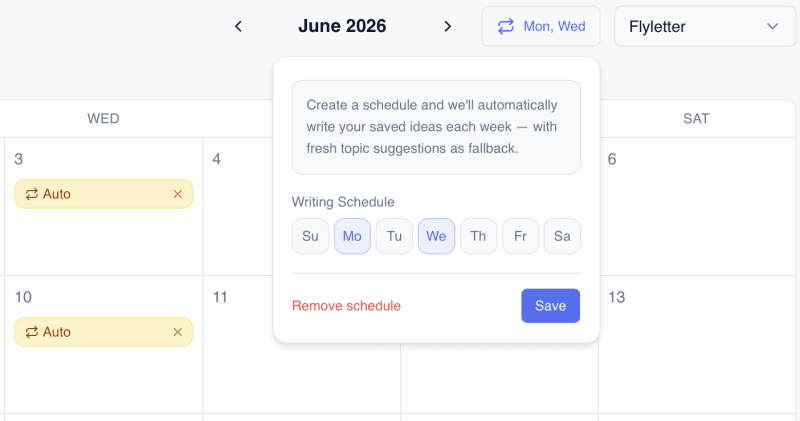
Okay, so now you have a runway of endless content. Next, load your newsletter topic ideas into Flyletter.
Flyletter's auto-write feature lets you schedule newsletter drafts to write on autopilot. You queue up your topics, set a schedule, and wake up to finished drafts waiting for your review.
The workflow looks like this:
- Load your topic queue into Flyletter as saved ideas
- Set your auto-write schedule (I run mine on Monday for a Tuesday send)
- Wake up to drafts already written in your voice
- Review, approve, and publish without missing a week
Companies using AI-powered content generation report reducing production time by up to 90%. And bloggers who use AI spend about 30% less time writing. The combination of systematic ideation plus automated drafting turns newsletter publishing from a weekly grind into a morning review session.
The compound effect: when your pipeline never runs dry
Something shifts when you stop worrying about what to write next.
You publish more consistently. Your audience starts to trust the rhythm. You build momentum that compounds over weeks and months. And because you're not burning creative energy on ideation, you actually have more of it for what matters.
Newsletter operators who survive the long game aren't the most talented writers. They're the ones who built systems that work without them.
Your topic pipeline should run whether you feel inspired or not. Your drafts should write themselves while you sleep. That's the system.
Remember those 30 minutes you used to spend convincing yourself you had nothing to say? Now you're spending them reviewing drafts that were already written for you.
Pick one method from this list. Run it today. Load your first batch of topics into Flyletter and schedule your first auto-write.
Tomorrow morning, you'll wake up to a draft instead of a blank page.